

Anomaly Detection in Weighing Data: How AI Distinguishes Noise from Error
In any weighing system — from laboratory balances to industrial platforms — raw signals are rarely perfect. Environmental interference, electrical noise, and mechanical disturbances can distort readings. The challenge lies in distinguishing harmless fluctuations from true measurement errors. AI-based anomaly detection provides a scalable, data-driven way to identify and classify these deviations in real time.
What Is Anomaly Detection?
Anomaly detection is the process of recognizing patterns in data that deviate from normal behavior. In weighing applications, anomalies can be caused by temporary disturbances or permanent faults. Artificial intelligence uses historical datasets to define what “normal” looks like — then flags any behavior outside that range.
- Normal Variation: Acceptable fluctuations due to temperature or load dynamics.
- Transient Anomalies: Short spikes caused by vibration, EMI, or handling.
- Systematic Errors: Persistent deviations indicating calibration drift or sensor damage.
Sources of Noise in Weighing Systems
- Mechanical Vibration: From conveyors, mixers, or nearby machinery (isolation techniques).
- Temperature Fluctuation: Thermal expansion alters strain-gauge resistance.
- Electromagnetic Interference: Signal corruption from nearby drives or radio sources.
- Load Disturbances: Motion during filling or dosing cycles.
- Electrical Grounding Issues: Irregular signal returns or floating reference voltages.
AI Techniques for Anomaly Detection
- Statistical Thresholding: Detects outliers based on standard deviation or variance.
- Unsupervised Learning: Clustering algorithms (e.g., K-Means, DBSCAN) separate normal vs. abnormal patterns without labels.
- Autoencoders: Neural networks trained to reconstruct normal signals — large reconstruction errors reveal anomalies.
- Recurrent Models (LSTM): Capture temporal dependencies in continuous weight data streams.
- Hybrid Systems: Combine rule-based limits with machine learning for adaptive thresholds.
Data Requirements and Preprocessing
High-quality anomaly detection depends on consistent data collection and feature engineering. Noise must be reduced without erasing real signal variation.
- Sampling Rate: Sufficient to capture vibration frequencies relevant to the process.
- Signal Filtering: FFT or low-pass filters to isolate true weight response (FFT analysis).
- Feature Extraction: Metrics such as skewness, kurtosis, RMS noise, or settling time.
- Normalization: Scaling signals across different load ranges for model consistency.
Practical Applications
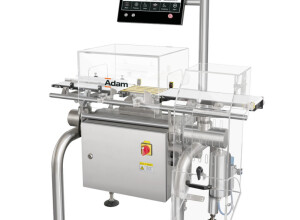
- Production Lines: Detect filling nozzle blockages or packaging vibrations in checkweighers.
- Truck Scales: Identify motion-related disturbances in weigh-in-motion systems.
- Laboratories: Flag drift caused by air drafts or micro-vibrations in precision balances.
- Smart Maintenance: Trigger alerts in AI diagnostics before load cell failure occurs.
Integration with Weighing Control Systems
AI anomaly detection works best when embedded within the control architecture:
- Edge Processing: Detect short-term disturbances directly on the weighing terminal (Edge-AI load cells).
- Data Gateway: Aggregate multiple devices for system-level anomaly correlation (edge gateways).
- Cloud Analysis: Identify long-term drift trends and cross-site performance deviations.
- Feedback Loop: Auto-adjust filters or calibration coefficients based on model output.
Benefits
- Early detection of faults or environmental issues.
- Reduced false rejections and improved quality assurance.
- Automatic adaptation to new product types or load ranges.
- Higher data confidence for compliance and audits.
Challenges and Considerations
- Data Drift: Models must retrain periodically to reflect process evolution.
- Explainability: Clear thresholds and visualization help operators trust AI decisions.
- Model Validation: Testing against certified reference weights is required for metrological acceptance.
- Cybersecurity: Protect streaming data against injection or manipulation (secure data transmission).
Future Outlook
AI-driven anomaly detection will soon become standard in all digital weighing instruments. Instead of reacting to errors, scales will autonomously identify, classify, and even correct anomalies in real time — creating self-stabilizing weighing systems that ensure precision under any condition.
Related Articles
- AI Diagnostics for Load Cells: Predicting Failure Before It Happens
- From Data to Insight: How Machine Learning Optimizes Weighing Accuracy
- Isolation Techniques: How to Eliminate Vibration in High-Precision Weighing